Home - About AR - Learning Material - Exams - Clubs - Posters
Some of the important waveforms are the "pure" sine, such as RF carriers and control tones. Square waved transition between two levels rapidly, and are the most usual signals in digital circuits. Sawtooth waves are of use in scanning traces across CRO and CRT TV screens. Voice and musical sounds are irregular waveforms which can be rich in harmonics.
These electrical signals generally vary over time, which can be seen on an oscilloscope.
Fourier analysis tells us that a squarewave can be thought of being made up of a the fundamental and odd harmonics, at progressively reducing levels.
If you look at frequency analysis of a squarewave you will see the fundamental at a high level. The third harmonic will be present at one third the level of the fundamental. The fifth will be at a fifth the level; the seventh at one seventh the level. This continues up the spectrum.
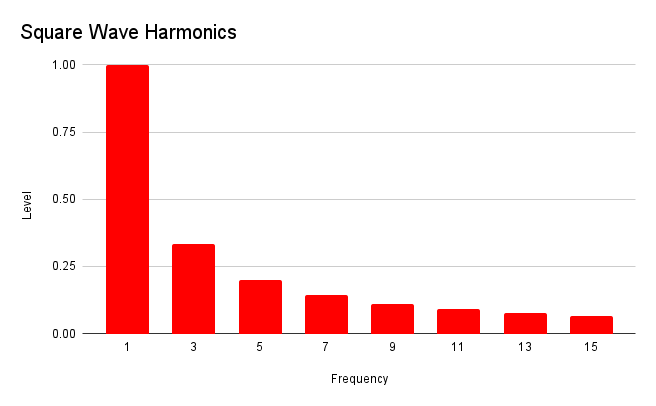
An FFT (Fast Fourier Transform) module in a digital 'scope allows it to act a Spectrum Analyser. There are also analogue spectrum analysers. These display levels in the frequency domain, rather than the time domain. In the above case the lines would be very much thinner than shown.
Off the exam, this explains why if an amplifier is overdrive, and the sinewave become flat-topped, harmonic distortion become evident. With most home electronics and even "inverter" air-conditioners using a supply which rectifies the mains and charges a capacitor current draw is primarily at the peak of the mains waveform. This means the mains waveform is often somewhat flat-topped too, and thus this distortion creates harmonics.
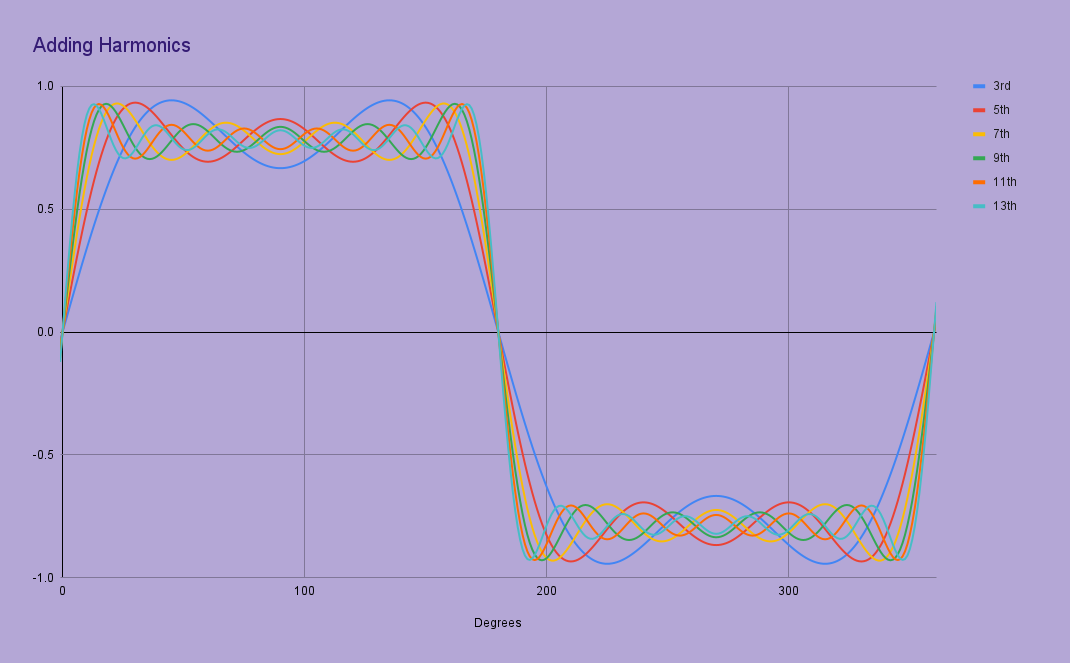
Noting that the B column contained conversions from the degrees value in column A to radians, the formula for the one including the 13th harmonic is:
=sin(B2)+sin(B2*3)/3+sin(B2*5)/5+sin(B2*7)/7+sin(B2*9)/9+sin(B2*11)/11+sin(B2*13)/13
This graph showing that adding more and more odd harmonics makes a wave with a sharper rise and fall, and typically a flatter horizontal section. Going to 1001 harmonics makes a wave which appears totally flat, with just a small overshoot and over-recovery after the rise or fall, and a tiny wobble just before the change. A pure sinewave would rise less steeply than the blue line, and touch the 1.0 line.
These show squarewaves containing up to the 15th, 31st, and 45th harmonic, and up to 15th, 31st and 45th harmonic. Close ther new window when finished, or flick back to this one (Ctrl-Shift-Tab).
Normally a simple oscillator of some sort is used to generate these waves, or they are they a stream of data, such as on the serial cable between a computer and a packet TNC or a modem.
beyond the exam: If all (odd and even) harmonics are present, the waveform becomes a sawtooth wave. These are not symmetrical triangular waves, but either start at a negative level before rising to a linearly positive one, then dropping back to negative; or start positive, and decline to a negative one, before jumping back to positive. In the plots linked to below those with the last harmonic being odd cross the 0 line (at 180 degrees) at the same angle as the sine wave (fundamental) does. The even ones have a horizontal component at this point.
These show sawtooth waves with 2nd to 8th harmonics, and up to 21st and 36th harmonic. Close the new window when done, or switch back to this one.
These can be generated with a free-running oscillator, such as in a conventional cathode ray oscilloscope on automatic trigger with no input, although once a signal of present this triggers based on the signal. Tube TVs and monitors trigger based on sync signals.
There are range of analogue to digital conversion methods, each suitable for different uses. Successive approximation is an example. This works by having in internal D-to-A generate a voltage at half the reference voltage to compare to the incoming signal. Depending if it is higher or lower comparison is them made to a ¼ or ¾ reference level, then by eighths, sixteenths, etc until a a full evaluation is made, with each step generating a bit.
The number of levels which can be measured by a system is dependent dependant on number of bits used. The formula is N = 2n, so an 8 bit system can have 256 levels.
Total Harmonic Distortion (TDM) is a widely used measure of audio quality. It is measured in percent, with a lower figure being better. A clean sinewave oscillator is fed into an audio circuit, and signal components which are not part of a pure sine wave appearing at the output are measured. This can be used on amplifiers, broadcast systems, and analog-to-digital and digital-to-analog converters.
Flash digitisation uses a very large number of comparators to evaluate the level in a single step. This speed allows direct digitisation of RF signals. They are also used in instruments such as Digital Storage Oscilloscopes.
Low cost multimeters are sensitive to the average level of an AC signal, and factor the display to RMS, based on the assumption that the measured signal is a sine wave. If the signal is a square wave, or has a high crest factor, or harmonic content, the reading will not be accurate. To obtain a true RMS (root mean squared) reading for any waveform, a meter containing an IC which converts the signal to an accurate representation of the RMS value is used.
These do not have to be expensive, with the Element 14having the 6000 count MP730026 EU-UK at just under A$60 including GST.
Major Tech have true RMS meters at A$85 and A$100 via Instrument Choice in northern Adelaide, and various electricians' suppliers. For distributors see: Major Tech Australia. They also sell hand tools, including many rated for live working. They are around 750 Rand in South Africa. Laserman has their products in the UK.
Altronics also have several True-RMS meters, as do Jaycar.
As always, remember that CAT ratings need to be taken notice of, and I'd avoid using a meter bought directly from China on a high energy circuit.
However, just because a Fluke meter costs hundreds of dollars does not mean it is True-RMS; it may still be sold because a US military calibration manual from 1991 for a piece of equipment specifies a certain value on that specific meter.
In SSB systems power is measured using Peak Envelope Power. The amount of energy is in a 2.5 watt PEP signal is equivalent to that in a 1 watt AM or CW one. The examiner has added that they are discussing unprocessed speech, as adding compression, in this case meaning that the average level is increased.
The modulation index of an FM signal is the deviation of the transmitted signal divided by the modulating signal frequency.
If a 2200 Hz tone from a packet modem is causing a deviation of plus and minus 4.4 kHz (4400 Hz), then the modulation index at that moment is 2.
Deviation ratio is the ratio of maximum permitted deviation to maximum permitted audio input frequency. The formula is the same.
If the maximum input frequency is 4 kHz, and the maximum deviation is ±5 kHz, then the deviation ratio is 5 / 4 = 1.25.
Sometimes we need to combine signals onto a single bearer or carrier. This can be anything from 2 to hundreds or more.
One method is frequency based, with signal modulated using different carriers. Before optical fibre, an example using SSB to modulate multiple telephone calls one a single thick coaxial cable running between cities, each at a different (suppressed) carrier frequency.
Time division multiplexing combines multiple slower digital streams into a faster one. Telex used to run at 50 baud, far slower than the data carrying capacity of a single pair. Thus at a local exchange the 20 or so Telex signals from a district could be combined onto a single pair to send into the city centre Telex exchange by sampling each Telex line in turn 50 times per second. Thus a 1000 bit per second signal can carry 20 Telex messages at once.
Telecom's "DATEL" DDN used multiplexing, combining multiple streams of a few kbps each, or say 30 voice channels over a 2 Mbs using copper pair(s), then to 8 Mbps, then 34 Mbps, and up to 144 Mbps to go over fibre, coax or microwave bearers; or 576 Mbps over fibre. As with a physical leased line from every bank branch to their data centres, and every betting venue to their HQ, DDN's provided the ability for every branch to have 100% capacity at any one time. The upper rates were later increased as business data needs increased beyond a few hundred bytes for a bank transaction, transport booking, or gambling transaction (using simple terminals), and users increased. Companies went to proprietry software on the desktop, then to bloated web based interfaces, in many cases.*
Moving off the paper, this is different to aggregation, where a dodgy ISP might sell you and 100 of your neighbours each a 100 Mbps service, but has under a gigabit per second of backhaul. While all do this to some extent, a good one has larger backhaul (say several Gbps) for this many customers. But it does explain why your download of a software update is faster at 7 am than 7 pm. If you are just downloading pages consisting of 100 kB or so of simple HTML (text) and images, then spending several minutes reading it this is OK. It is not so good if many multiple users are streaming 4K or UHD TV.
*Plus businesses do weird and data intensive things, such as having checkouts running as a web app from a central location, rather than using local databases for prices, which is why Cloudflare failing took down supermarkets checkouts!!!
Orthogonal Frequency Division Multiplexing is a modulation method for transferring large amounts of data wirelessly. It is used in various cellular / mobile telephone systems, and in Wi-Fi. It uses multiple sub-carriers across the channel.
Time Division Multiple Access was the system used during the 1990s and early 2000s in GSM and some other digital mobile phone systems. This resulted in the "blatt-blatt-blattedy-blatt", and especially the loud buzzing introduced into things like car stereos and PA systems due to the rapid pulsing on and off of the signals due to the sharing of channel among 8 users at a time. Time of travel of the signal also limited range to 32 km as otherwise your timeslot would expire before your packet go to the base station, and that packet could interfere with that of the next user.
TDMA is used in Tier II DMR to provide two time slots, allowing two conversations. Using VK-DMR in Australia TG 505 is the national calling talk group on Time Slot 2 (TS2) which all such repeaters are permanently to, and which will be transmitted to any radio monitoring 505. Once a contact is made the users can then move to a user activated TGs, such as those in the 3801 to 3809 range, using TS1. WICEN members may join a net on 3810 by briefly keying up on this TG a minute or so before the advertised start time so the repeater listens to and transmits this TG, then join the net when the net controller calls for paricipants.
Other DMR networks use TDMA, but operating proceedures may be different.
These are the actual questions from the Extra licence exam pool, as published by the NCVEC.
E8A01
What technique shows that a square wave is made up of a sine wave and its odd harmonics?
A. Fourier analysis
B. Vector analysis
C. Numerical analysis
D. Differential analysis
This is Fourier analysis, answer A.
E8A02
Which of the following is a type of analog-to-digital conversion?
A. Successive approximation
B. Harmonic regeneration
C. Level shifting
D. Phase reversal
This is successive approximation, answer A.
E8A03
Which of the following describes a signal in the time domain?
A. Power at intervals of phase
B. Amplitude at different times
C. Frequency at different times
D. Discrete impulses in time order
If you observe a signal on an oscilloscope you will see the amplitude of the signal over time, answer B.
While this can move very slowly, such as a 0 to 5 volt signal indicating as tank level, more usually this is a more rapidly changing signal, be it a sinewave, or an audio or RF signal subject to modulation.
E8A04
What is "dither" with respect to analog to digital converters?
A. An abnormal condition where the converter cannot settle on a value to represent the signal
B. A small amount of noise added to the input signal to reduce quantization noise
C. An error caused by irregular quantization step size
D. A method of decimation by randomly skipping samples
Dithering means adding noise to a signal, so answer B.
E8A05
What is the benefit of making voltage measurements with a true-RMS calculating meter?
A. An inverse Fourier transform can be used
B. The signal's RMS noise factor is also calculated
C. The calculated RMS value can be converted directly into phasor form
D. RMS is measured for both sinusoidal and non-sinusoidal signals
These provide the accurate RMS value of both sinewave and non-sinewave signals, answer D.
The previous pool's question asked for the device suitable for accurately measuring the RMS voltage of a complex waveform.
E8A06
What is the approximate ratio of PEP-to-average power in an unprocessed single-sideband phone signal?
A. 2.5 to 1
B. 25 to 1
C. 1 to 1
D. 13 to 1
This is 2.5:1, meaning that if we have an SSB transmitter which is 12.5 watts PEP, the energy is about the same as a 5 W AM transmitter, answer A.
E8A07
What determines the PEP-to-average power ratio of an unprocessed single-sideband phone signal?
A. The frequency of the modulating signal
B. Speech characteristics
C. The degree of carrier suppression
D. Amplifier gain
This is the characteristics of the speech presented to the radio, answer B.
E8A08
Why would a direct or flash conversion analog-to-digital converter be useful for a software defined radio?
A. Very low power consumption decreases frequency drift
B. Immunity to out-of-sequence coding reduces spurious responses
C. Very high speed allows digitizing high frequencies
D. All these choices are correct
Its high speed allows digitising of radio frequency signals, answer C.
E8A09
How many different input levels can be encoded by an analog-to-digital converter with 8-bit resolution?
A. 8
B. 8 multiplied by the gain of the input amplifier
C. 256 divided by the gain of the input amplifier
D. 256
Simples! 28 = 256, answer D.
E8A10
What is the purpose of a low-pass filter used at the output of a digital-to-analog converter?
A. Lower the input bandwidth to increase the effective resolution
B. Improve accuracy by removing out-of-sequence codes from the input
C. Remove spurious sampling artifacts from the output signal
D. All of these choices are correct
The steps between samples may cause artefacts in the audio stream, which this filter removes, answer C.
The previous answer indicated that there were harmonics. In either case they detract from audio quality.
E8A11
Which of the following is a measure of the quality of an analog-to-digital converter?
A. Total harmonic distortion
B. Peak envelope power
C. Reciprocal mixing
D. Power factor
Any audio system, including an A-to-D, can be assessed in terms of its Total Harmonic Distortion, answer A.
E8B01
What is the modulation index of an FM signal?
A. The ratio of frequency deviation to modulating signal frequency
B. The ratio of modulating signal amplitude to frequency deviation
C. The modulating signal frequency divided by the bandwidth of the transmitted signal
D. The bandwidth of the transmitted signal divided by the modulating signal frequency
This is the ratio of frequency deviation to modulating signal frequency, answer A.
E8B02
How does the modulation index of a phase-modulated emission vary with RF carrier frequency (the modulated frequency)?
A. It increases as the RF carrier frequency increases
B. It decreases as the RF carrier frequency increases
C. It varies with the square root of the RF carrier frequency
D. It does not depend on the RF carrier frequency
The modulation index relates to deviation, not carrier frequency, answer D.
E8B03
What is the modulation index of an FM phone signal having a maximum frequency deviation of 3000 Hz either side of the carrier frequency if the highest modulating frequency is 1000 Hz?
A. 3
B. 0.3
C. 6
D. 0.6
3000 / 1000 = 3, answer A.
E8B04
What is the modulation index of an FM phone signal having a maximum carrier deviation of plus or minus 6 kHz if the highest modulating frequency is 2 kHz?
A. 0.3
B. 3
C. 0.6
D. 6
6 / 2 = 3, answer B.
E8B05
What is the deviation ratio of an FM phone signal having a maximum frequency swing of plus or minus 5 kHz if the highest modulation frequency is 3 kHz?
A. 6
B. 0.167
C. 0.6
D. 1.67
5 / 3 = 1.666667, answer D.
E8B06
What is the deviation ratio of an FM phone signal having a maximum frequency swing of plus or minus 7.5 kHz when the maximum modulation frequency is 3.5 kHz?
A. 2.14
B. 0.214
C. 0.47
D. 47
7.5 / 3.5 = 2.14, answer A.
E8B07
Orthogonal frequency-division multiplexing (OFDM) is a technique used for which types of amateur communication?
A. Digital modes
B. Extremely low-power contacts
C. EME
D. OFDM signals are not allowed on amateur bands
OFDM is used in high-sped digital modes, answer A.
E8B08
What describes orthogonal frequency-division multiplexing (OFDM)?
A. A frequency modulation technique which uses non-harmonically related frequencies
B. A bandwidth compression technique using Fourier transforms
C. A digital mode for narrow-band, slow-speed transmissions
D. A digital modulation technique using subcarriers at frequencies chosen to avoid intersymbol interference
This is the digital modulation method used in Wi-Fi, including when used on Amateur microwave frequencies. It uses multiple subcarriers, answer D.
E8B09
What is meant by deviation ratio?
A. The ratio of the audio modulating frequency to the center carrier frequency
B. The ratio of the maximum carrier frequency deviation to the highest audio modulating frequency
C. The ratio of the carrier center frequency to the audio modulating frequency
D. The ratio of the highest audio modulating frequency to the average audio modulating frequency
This is the ratio of the maximum deviation to the highest audio frequency, answer B.
E8B10
What is frequency division multiplexing (FDM)?
A. The transmitted signal jumps from band to band at a predetermined rate
B. Dividing the transmitted signal into separate frequency bands that each carry a different data stream
C. The transmitted signal is divided into packets of information
D. Two or more information streams are merged into a digital combiner, which then pulse position modulates the transmitter
Information streams can be modulated onto subcarriers, and then modulated into a radio signal, answer B.
E8B11
What is digital time division multiplexing?
A. Two or more data streams are assigned to discrete sub-carriers on an FM transmitter
B. Two or more signals are arranged to share discrete time slots of a data transmission
C. Two or more data streams share the same channel by transmitting time of transmission as the sub-carrier
D. Two or more signals are quadrature modulated to increase bandwidth efficiency
TDM has packets from two or more data streams sent in different timeslots, such as in GSM or DMR, answer B.
On to: Signals & Emissions 2 - Digital
You can find links to lots more on the Learning Material page.
Written by Julian Sortland, VK2YJS & AG6LE, January 2026.
Tip Jar: a Jefferson (US$2), A$3 or other amount / currency. Thanks!
You can also buy me a non-coffee beverage (or contribute to other expenses): ko-fi.com/ag6le